

Table of Contents
- Discover the Medieval Charm of Arco degli Acetari
- Stroll Through the Liberty Art Passage of Galleria Sciarra
- Uncover the Hidden Frescoes in Passetto del Biscione
- Experience the Optical Illusion at Palazzo Spada
- Explore the Antique Stone Collection at Palazzo Mattei di Giove
- Unlock the Secrets of the Eternal City
- Curious Explorer Queries
Step away from the roaring crowds at the Trevi Fountain and let the city whisper its secrets to you.
Rome is not just grand piazzas and ancient ruins; it is a labyrinth of ivy-draped entries that lead into silence.
Behind heavy wooden doors lies a world of trickling fountains and sun-warmed terracotta where time seems to stand still.
This guide is your key to unlocking private sanctuaries usually reserved for residents and curious cats.
We will navigate narrow cobblestone alleys to find Renaissance arches and lush gardens hidden in plain sight.
You do not need a history degree or a velvet rope invitation to experience the quiet grandeur tucked away in districts like Trastevere and Monti.
Exploring these spaces requires a gentle step and a respectful nod to the locals who call these courtyards home.
Slow down to smell the jasmine and notice the play of light on centuries-old stucco.
Pack comfortable walking shoes and prepare to see the Eternal City through its most intimate and enchanting lens.
The Explorer’s Cheat Sheet
- Step into a medieval time capsule at Arco degli Acetari, where silence and ochre walls create a striking escape from Rome’s noise.
- Uncover the working-class history of this former vinegar makers’ depot, which once served the nearby Campo de’ Fiori market.
- Find the hidden entrance near Via del Pellegrino 19 by looking for a dark archway that feels like a private drive.
- Respect the local residents by keeping your voice low and avoiding intrusive photography in this living, breathing neighborhood.
Discover the Medieval Charm of Arco degli Acetari
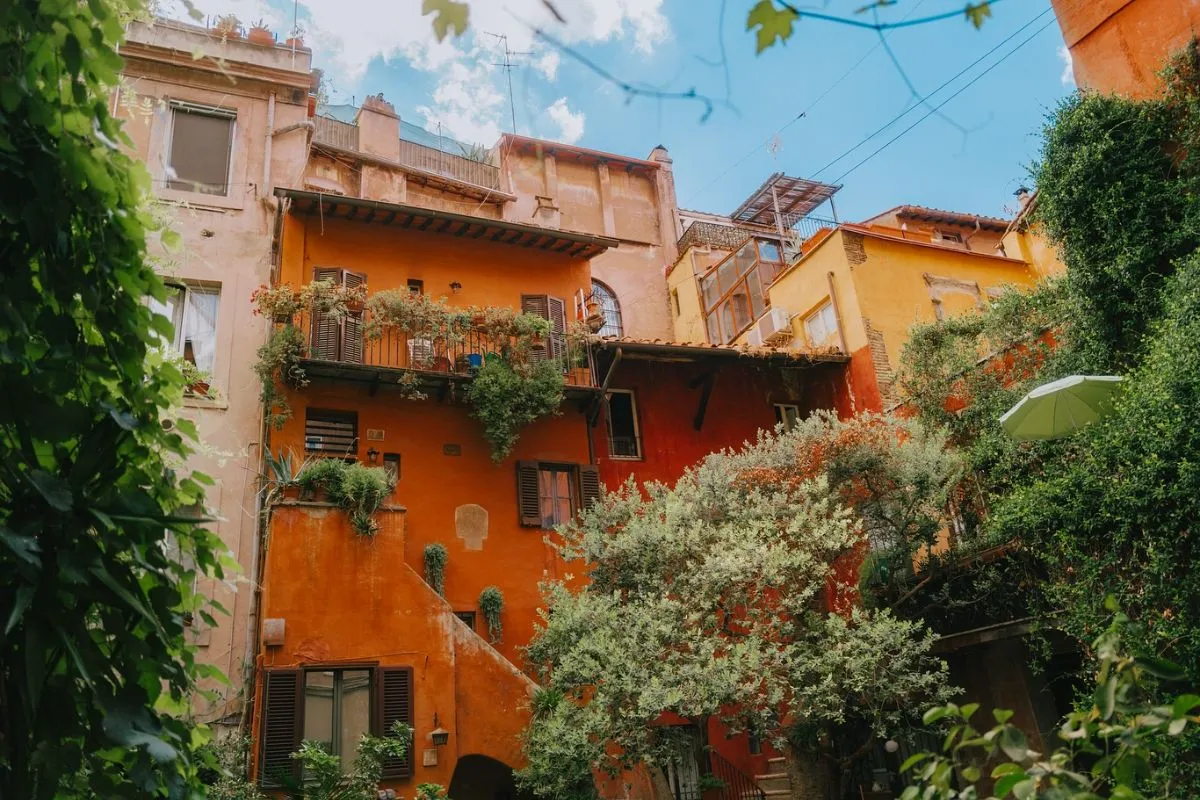
Step away from the noise of Via del Pellegrino. You are about to enter a medieval time capsule. The silence here feels heavy and ancient.
This is Arco degli Acetari. It is a hidden enclosure that feels miles away from the modern city. The contrast is sudden and striking.
Ochre walls lean inward, draped in cascading ivy. The cobblestones beneath your feet are worn smooth by centuries of history.
Rome’s true magic isn’t in the Colosseum, but in the silence of a hidden courtyard found by accident.
🏛️ Arco degli Acetari
Free
Medieval Courtyard: A hidden medieval enclosure featuring ochre walls and cascading ivy, originally a depot for vinegar makers.
- Former depot for vinegar makers (Acetari)
- Ochre walls draped in cascading ivy
- Medieval architecture preserved like a time capsule
A Glimpse into Roman History
The name “Acetari” refers to vinegar makers. This enclosed square was once a depot for vinegar water sold at the nearby Campo de’ Fiori market.
It was a working-class hub long before it became a scenic stop. The architecture reflects a time when utility mattered more than grandeur.
You can smell the history here. The air carries a faint scent of damp stone and sometimes fresh laundry hanging from the upper windows.
If you enjoy discovering local customs, read about Aperitivo in Italy: How I Do It. It captures the same slow pace found in this courtyard.
Finding the Entrance
Locating this gem requires keen eyes. Look for a dark archway near Via del Pellegrino 19. It looks like a private drive, but you can enter.
Walk through the tunnel. The darkness gives way to amber light as the courtyard opens up. It feels like stepping onto a movie set.
This picturesque medieval courtyard seems to have stopped in time… vivid colours of the houses, the external stairs and the greenery.
Turismo Roma, Arco degli Acetari Official Guide
Respecting the Residents
This is not a museum. Real Romans live here. You will likely see cats sleeping on doorsteps and residents watering their plants.
Keep your voice low. The acoustics in the square amplify every whisper. Silence is part of the experience, so preserve it for others.
Avoid taking photos of people inside their homes. If you want to improve your shots, check How I Took Stunning Travel Photos with Just a Camera.
Visitor Etiquette Guide
To ensure these places remain open to the public, follow these simple rules. Local residents appreciate travelers who are discreet.
| Action | Status | Why? |
|---|---|---|
| Photography | ✅ | Allowed, but focus on architecture, not open windows. |
| Loud Talking | ❌ | The walls echo sound into private apartments. |
| Picnicking | ❌ | This is private property; do not sit on doorsteps. |
| Early Morning | ✅ | Best lighting and fewest crowds for atmosphere. |
Visiting early in the morning is best. The light hits the orange walls softly. It is the perfect time for quiet contemplation.
Uncovering the Secret of Arco degli Acetari
- Locate the hidden entrance near Via del Pellegrino 19 to step directly into a secluded medieval time capsule.
- The name “Acetari” traces back to the vinegar makers who once used the square as a depot for the Campo de’ Fiori market.
- Experience an authentic atmosphere defined by ochre walls, cascading ivy, and ancient cobblestones worn smooth by time.
- Remember to keep your voice low and respect privacy, as this picturesque courtyard remains a home for local residents.
Stroll Through the Liberty Art Passage of Galleria Sciarra

Just a stone’s throw from the chaotic Trevi Fountain lies a hushed architectural marvel. The Galleria Sciarra is a rare masterpiece of Liberty-style art in Rome.
Entering this courtyard feels like stepping inside a hand-painted jewelry box. The high vaulted ceiling is made of iron and glass, allowing soft light to filter in.
Galleria Sciarra is where the chaotic energy of Rome transforms into a whisper of Art Nouveau elegance.
🗽 Galleria Sciarra
Free
Liberty Art Passage: A stunning Art Nouveau pedestrian passage featuring a glass-vaulted ceiling and intricate frescoes.
- Masterpiece of Liberty style (Art Nouveau)
- Frescoes by Giuseppe Cellini depicting the ‘Glorification of Women’
- Iron and glass vaulted ceiling
The Frescoes and Symbolism
Look up to admire the intricate artwork painted by Giuseppe Cellini in the late 19th century. The frescoes depict the “Glorification of Women” in various domestic roles.
You will see figures representing virtues such as Fidelity, Strength, and Modesty. The colors are rich ochres and terracotta reds that glow under the glass roof.
This style of architecture is distinct from the Baroque structures you might see on a trip to Venice. It offers a unique glimpse into the fashion of the late 1800s.
An Art Nouveau jewel… the Galleria Sciarra was initially intended as a shopping arcade but is now a pedestrian passage.
Lonely Planet, Galleria Sciarra Highlights
Practical Visiting Logistics
While this passage is technically private property, it remains open to the public during business hours. It serves as a walkway for local office workers.
Because it functions as an office building, silence is appreciated. Keep your voice low to respect the people working behind the windows.
If you enjoy hunting for secret spots like this, you might also like finding hidden gems in New York. City passages offer a quiet break from urban noise.
| Feature | Details |
|---|---|
| Location | Via Marco Minghetti, 10 (Trevi District) |
| Entrance Fee | Free (Public Pedestrian Passage) |
| Opening Hours | Monday to Friday, roughly 9:00 AM to 6:30 PM |
| Best Time to Visit | Noon, when sunlight hits the glass roof directly |
The gates are usually closed on weekends and public holidays. Plan your visit for a weekday morning to ensure you can walk through the entire passage.
Rome’s Art Nouveau Secret
- Discover a rare masterpiece of Liberty-style architecture hidden just steps from the Trevi Fountain.
- Admire Giuseppe Cellini’s intricate frescoes depicting the ‘Glorification of Women’ under a vaulted glass roof.
- Plan your visit for weekdays during business hours, as the passage is closed on weekends.
- Respect the quiet atmosphere by keeping your voice low, as the building houses active offices.
Uncover the Hidden Frescoes in Passetto del Biscione

Just steps away from the chaotic energy of Campo de’ Fiori lies a sanctuary of silence. Most tourists walk right past the narrow entrance.
The Passetto del Biscione is not just a shortcut; it is a hidden gallery that feels suspended in time. The air here is instantly cooler.
As you step under the arch, the roar of the market fades into a hush. You have entered a space built upon the ancient Theater of Pompey.
Look up immediately. The ceiling is a masterpiece of Renaissance-style frescoes. Restored in recent years, the colors are remarkably vivid.
Rome reveals her best secrets only to those who dare to stop, look up, and embrace the quiet shadows.
You will see cherubs, garlands, and faux architectural details painted against a deep blue sky. It creates an illusion of infinite height.
🏛️ Passetto del Biscione
Free
Frescoed Passage: A secluded passageway built upon the ancient Theater of Pompey, adorned with Renaissance-style ceiling frescoes.
- Built on the foundations of the ancient Theater of Pompey
- Features vivid Renaissance-style ceiling frescoes
- Connects Piazza del Biscione to Via di Grottapinta
How to Find the Secret Entrance
Finding this passage requires a keen eye. Head to Piazza del Biscione, a small square branching off the main market area.
Look for a modest archway connecting the buildings. It connects the piazza to Via di Grottapinta. The architecture here is curved.
This curve is not accidental. The buildings were constructed directly on the foundations of the ancient Roman theater’s auditorium.
If you are planning a longer Italian journey, this layering of history is similar to what you might find during Three Days in Venice, Italy.
It is a secret tunnel where the clamor of the city falls away… the frescoes are a reminder of the city’s artistic soul.
Wanted in Rome, Rome reopens historic Passetto del Biscione
While the passage is beautiful, it is also a functional street. Locals use it to bypass the crowds. Respect their space as you take photos.
For photographers, the lighting is challenging. The contrast between the dark tunnel and the bright exits requires a steady hand.
Practical Logistics for Visitors
This is a quick stop, perfect for bridging the gap between major sites. Use the table below to plan your visit efficiently.
| Feature | Traveler Details |
|---|---|
| Location | Connects Piazza del Biscione & Via di Grottapinta |
| Cost | Free (Public Street) |
| Best Time | Early morning for soft light and solitude |
| Time Needed | 10 – 15 minutes |
| Safety | Safe by day; avoid late nights alone |
After visiting, you are perfectly positioned to explore more. The area is dense with history and excellent food options.
For those organizing their own grand tour, learning How I Planned My First Europe Trip can help you uncover more gems like this.
Unlocking the Passetto’s Secrets
- Discover a quiet sanctuary featuring stunning Renaissance-style ceiling frescoes just steps from the bustling Campo de’ Fiori.
- Observe the unique curved architecture of the passage, a physical remnant of the ancient Theater of Pompey’s foundation.
- Find the entrance at Piazza del Biscione to traverse the scenic shortcut connecting the square to Via di Grottapinta.
- Prepare for challenging low-light photography conditions while respecting the locals who use the path daily.
Experience the Optical Illusion at Palazzo Spada

Step off the noisy streets near Campo de’ Fiori and into a world of visual trickery.
Palazzo Spada looks like a standard Renaissance palace, but it hides a massive secret.
The main attraction is the Perspective Gallery located in the internal garden.
Rome rewards the curious traveler who looks beyond the obvious facades.
The Masterpiece of Deception
At first glance, you see a majestic colonnade stretching far into the distance.
It appears to be about 35 meters long, lined with soaring columns.
This is the genius of Francesco Borromini, a rival of Bernini.
The gallery is actually only 8.8 meters in length.
Borromini raised the floor and lowered the ceiling to create this forced perspective.
The gallery is the most famous curiosity of the palace… a trompe l’oeil effect that makes the corridor appear four times its actual length.
The Editors, Fodor’s Travel
A Sensory Experience
The air here feels cooler and quieter than the bustling piazza outside.
You can smell the faint scent of bitter orange trees in the adjacent garden.
It is a perfect spot to escape the Roman heat and enjoy silence.
Staff members will often demonstrate the illusion for you.
They walk to the end of the corridor, appearing to grow into giants.
The statue at the end is only 60 centimeters tall, though it looks life-size.
Practical Logistics for Visitors
Unlike open courtyards, this requires a ticket as it is part of a museum.
The gallery is best visited in the morning to avoid tour groups.
| Feature | Details |
|---|---|
| Location | Piazza Capo di Ferro, 13 (Regola District) |
| Entry Fee | Approx. €5.00 (Check official site for changes) |
| Best Time | Weekdays, 9:00 AM to 11:00 AM |
| Nearby | Campo de’ Fiori Market |
After your mind is bent by geometry, head to a nearby piazza.
You can enjoy an Aperitivo in Italy: How I Do It (& Why It’s More Than a Drink) to relax.
Reflecting on Borromini’s trickery over a spritz is a true Roman tradition.
Borromini’s Architectural Trick
- The gallery features a famous optical illusion where a corridor spanning only 8.8 meters appears to be 35 meters long.
- Francesco Borromini created this forced perspective by skillfully raising the floor and lowering the ceiling.
- The statue at the end of the colonnade appears life-size from a distance but stands only 60 centimeters tall.
- Located in the Regola District, the palace offers a quiet sensory escape with cooler air and the scent of orange trees.
Explore the Antique Stone Collection at Palazzo Mattei di Giove

Step away from the chaos of the Jewish Ghetto. You will find a heavy wooden door that looks ordinary. Push it open to reveal a hidden world.
The Palazzo Mattei di Giove creates an immediate hush. The roar of scooters fades into silence. You are surrounded by history on every side.
This space was designed in the 17th century. The architect, Carlo Maderno, wanted to impress guests. He used ancient Roman statues to do it.
The courtyard is a theatrical space, designed to impress visitors with the family’s collection of antiquities. It is one of the most scenic in Rome.
The Blue Guide, Blue Guide Rome
Busts of emperors line the walls. They stare down at you with stone eyes. The geometry of the arches frames the sky perfectly.
If you love photography, bring your best lens. This location offers unique lighting conditions. The shadows play across the marble faces.
For advice on capturing high-contrast scenes like this, check my guide on How I Took Stunning Travel Photos with Just a Camera.
The atmosphere here is heavy with the past. You can smell the age of the stone. It is damp, cool, and carries the faint scent of old books.
Rome does not shout its beauty. Sometimes, it whispers it from behind a heavy wooden door.
Key Details to Spot in the Courtyard
Don’t just glance and leave. Take a moment to look closer at the walls. The details here are overwhelming if you rush.
- The Loggia: Look up to the second floor. The open arches create a stunning frame for the antique reliefs.
- The Staircase: To the left, a grand staircase rises. It is often decorated with more statues and urns.
- The Reliefs: Between the busts, you will see scenes of Roman hunts and myths carved into sarcophagus panels.
- The Fountain: A small fountain sits in the corner. The sound of trickling water adds to the peaceful vibe.
This building now houses the Center for American Studies. It is a functioning office and library. You must be respectful of the workers.
Entry to the courtyard is free. You do not need a ticket. However, you should keep your voice down. This is not a place for loud groups.
If you plan to drive to the city outskirts later, read What I Wish I’d Known Before Renting a Car in Italy. Driving here is tricky.
Visit during the morning on a weekday. The light is softest then. You will likely have the entire courtyard to yourself.
Rome’s Hidden World of Stone
- Locate the heavy wooden door in the Jewish Ghetto to access this free, 17th-century courtyard designed by Carlo Maderno.
- Admire the theatrical display of ancient Roman statues, busts, and sarcophagus reliefs lining the walls and loggia.
- Take advantage of the unique lighting and architectural frames for high-contrast photography of the marble details.
- Maintain a respectful silence inside, as the building houses the functioning offices of the Center for American Studies.
Unlock the Secrets of the Eternal City
Rome is more than just ancient ruins and crowded piazzas. The true soul of the city hides behind ivy-draped arches and silent cobblestone lanes.
Places like Arco degli Acetari offer a rare glimpse into medieval life. They remind us to slow down and look beyond the obvious tourist trails.
Remember to explore these residential gems with respect. Your silence ensures these secret passages remain open for future travelers to discover.
So, put away the map and let your curiosity guide you. The best memories are often found in the quiet corners you never planned to visit.
Curious Explorer Queries
Yes, the courtyard is technically open, but it is private property. You may enter to admire the architecture, but please respect the residents’ privacy.
No, visiting this hidden gem is completely free. It is a residential area, not a museum, so there are no tickets or official opening hours.
Late morning offers the best natural light against the ochre walls. Avoid late nights to ensure you do not disturb the locals sleeping nearby.
Yes. The surrounding streets, like Via del Pellegrino and Via dei Cappellari, are full of small arches and historic workshops waiting to be found.


